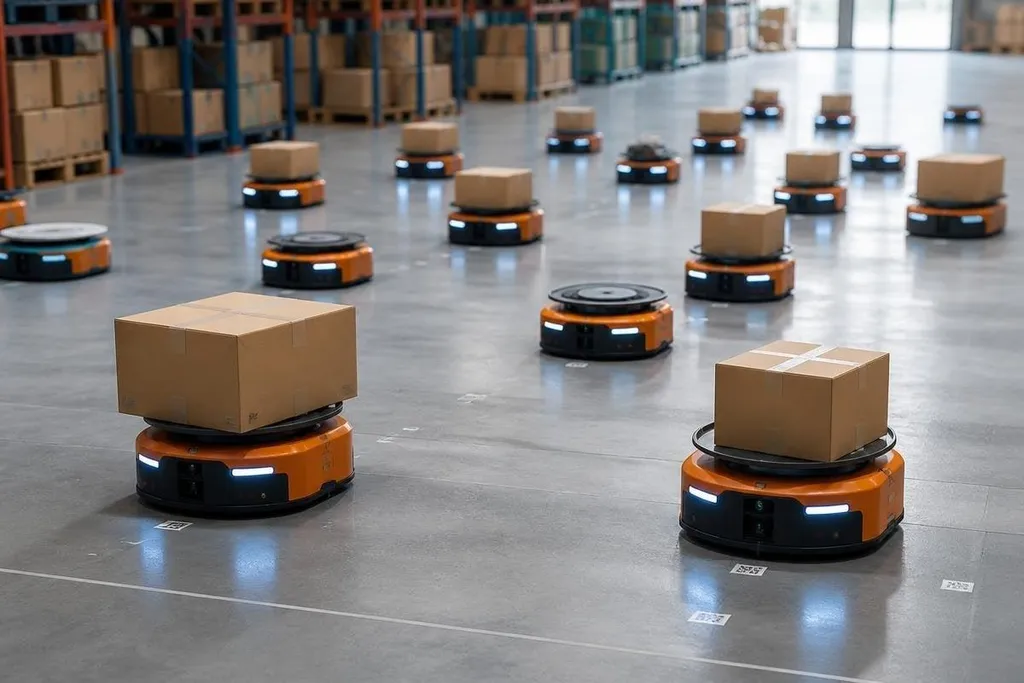
A swarm robot does not need to understand the whole job. It needs to sense nearby conditions, follow a few rules, and adjust when another robot changes position. Put enough of these machines together, and the group can handle work that would be hard for one large robot.
- Each robot makes local decisions instead of waiting for one central controller.
- The group can keep working when one robot stops.
- The hard part is coordination: radio links, task rules, charging, and safety.
How the group makes decisions
Swarm robotics borrows a simple idea from insects and other social animals: useful group behavior can come from many small actions. In a robot swarm, each machine checks its sensors, receives nearby messages, and chooses its next move from a set of rules.
Those rules may tell a robot to keep a safe distance, follow a signal, avoid an obstacle, or move toward an area with more work. No single robot needs a full map of the job. The group forms a working picture from local data.
This is distributed control. “Distributed” means the control work is spread across the robots instead of sitting in one computer. That matters when the work area changes, the network drops, or one machine fails.
A central controller can plan routes well when the site stays stable. Local control has an advantage when conditions shift faster than one planner can update them. The trade-off is that local rules can create poor choices if the robots receive bad data or lose contact with one another.
Why many small robots can help
The group can split a large task into smaller jobs. One group may inspect a floor, another may carry items, and another may mark areas that need human attention. The same basic robot can take a different role when the task changes.
That can reduce the cost of a single failure. If one robot loses power, the rest can continue and leave that unit for recovery. A large robot built around one arm or drive system may stop the whole job when one major part fails.
More robots let a system work in several places at once. A group of 10 machines can spread across a small work area.
A group of 1,000 needs tighter rules for traffic, radio use, and charging. More units do not remove the planning problem. They move it into the software and site design.
The approach fits jobs where the work is spread out or changes often. Search, inspection, farm work, warehouse movement, and environmental sensing can all use local decisions because the robots need to cover space rather than repeat one fixed motion.
A swarm demo deserves a closer look when it names the robot count, task, and test setting. Reports from Robot24.com can put those details beside the maker’s claim, so you can judge whether local decisions held up beyond a short run. The next limit is coordination.
The limits are in coordination
A swarm needs rules that prevent traffic jams. Robots must know when to stop, where to wait, and how to give way. They also need a safe response when a sensor fails or a message arrives late.
Communication creates another limit. A robot may work from local sensor data when the radio link fails, but it cannot share new findings until contact returns. That can split one group into smaller groups with different ideas about the job.
Charging takes planning too. If many robots return to the same station at once, the station becomes a work limit. A useful system needs a plan for battery state, charging order, spare units, and recovery after a fault.
Safety needs clear boundaries. A swarm moving around people cannot rely on group behavior alone. Each robot still needs its own stop function, obstacle detection, speed limits, and rules for handing work back to a person.
The system also needs testing outside clean demonstrations. A warehouse has blocked aisles, poor radio spots, reflective surfaces, tired batteries, and people who do not follow the robot’s expected path. I’d choose a smaller swarm that handles those cases over a larger group that only looks good in a clear test area.
A practical buying checklist
Before you approve a swarm robotics project, check these points:
- Name the task: State the work in a way you can measure, such as area inspected or items moved per hour.
- Set the failure rule: Decide what happens when one robot loses power, data, or contact.
- Test the network: Map weak radio areas and confirm how robots behave when messages stop.
- Plan charging: Count stations, charging time, battery swaps, and units kept ready for recovery.
- Set human controls: Give staff a clear stop method and a way to change or end a task.
- Measure the group: Compare the swarm with one robot and with manual work using the same task and site.
The next useful proof is not a larger robot count. It is a measured run in a messy work area, with one robot removed, one link lost, and a clear record of what the remaining group does.